
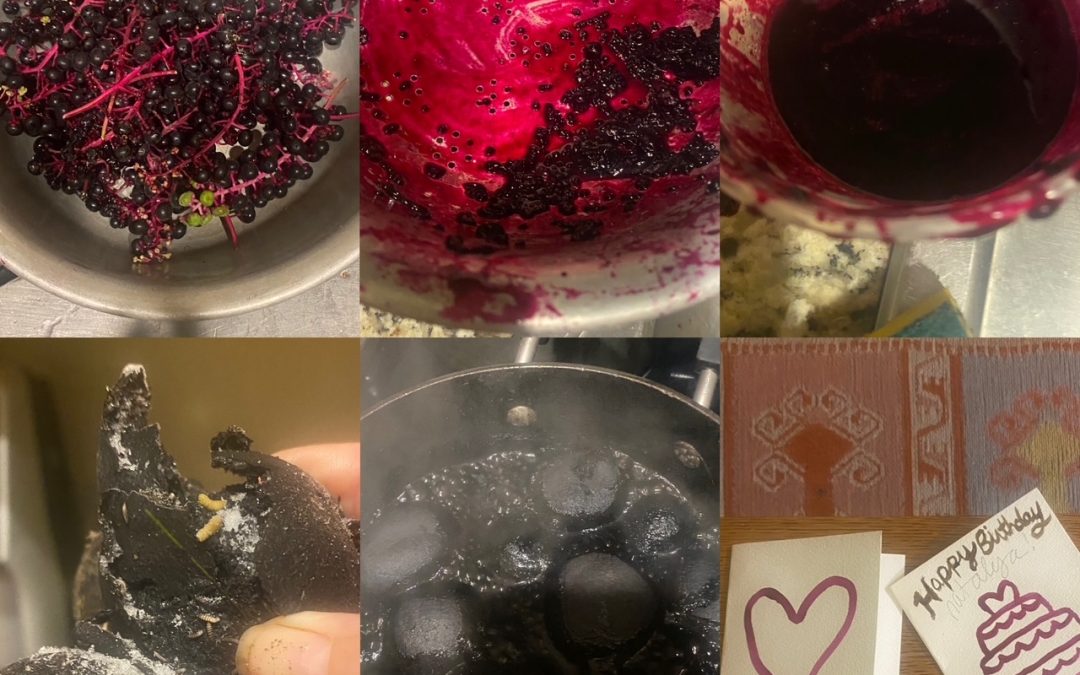
Happy September, food & foraging friends!
Freeze the nuts, they said, to kill the bugs. What they didn’t tell you is that the bugs would start running to try to escape freezing to death, a traumatizing sight to open your massive bag of black walnuts to.
This month, I finally got around to testing out a recipe for black walnut ink — decidedly easier than extracting the nuts themselves. I’d forgotten it was black walnut season until I was leading a walk for blind athletes in Rock Creek Park recently. I’d brought various non-visual aids to pass around to illustrate the many plants and fungi whose identifying characteristics were largely odor- and texture-based — things like the anise-scented polypore, candy caps, spicebush and turkey tail. The black walnut, still green in the hull, fit right in. Most participants pegged the freshly fallen nut fruits as having a citrusy aroma, but the blackened nuts simmering in my kitchen now smell like dirt, in a good way.
The nuts were a consolation prize, having gone out in search of the hen of the woods that everybody and their brother seem to be finding right now, and come back empty handed. With the help of my chef friend Iulian, I’d harvested and hulled them before, a messy, laborious process as their hulls are tougher than teeth enamel. Unlike their English cousins, which easily come out of their shells, black walnuts have to be pried from their crevices. But there is nothing so delicious as the native nut, the perfect addition to a fall ice cream flavor.
So, back to that paint job. I opened the bag of nuts to find dozens of little white grubs frozen on the surface of the hulls. Now, I had actually tried the grubs on a trip to Asheville, and learned that they are quite sweet, spending their short lives eating nothing but walnut. So being a zero-waste-of-lives kind of forager, I dethawed them and threw them into dinner.
Just kidding! I fed them to my cat Ninjette — who eats everything, except apparently grubs. She could neither see nor smell them and put her head right back down on my laptop and waited for something more interesting to be offered.
Being an impatient forager, within moments of cooking, I dipped my paintbrush into one of the crushed black hulls to test the waters. The recipe said to simmer for a good eight hours, but less than eight minutes in, the pigment was already dark enough to pen a greeting card!
There are many historical references for walnut ink (both our native black walnuts as well as European varieties) being used to ink medieval maps, drawings, manuscripts and more. The most intriguing reference I found was to mark the hands of ancient Roman prisoners, as the ink is so hard to remove.
The other paint I made this month was with pokeweed berry – one the best and brightest in nature’s palette. Unlike most botanical inks that need to be cooked down, poke ink is as easy as smashing the berries through a colander and adding a little alcohol or vinegar to preserve it. Pokeweed berry got the moniker inkberry from Civil War soldiers and other early Americans using it in their inkwells. Just don’t lick your fingers afterward — pokeweed berries are quite toxic.
I’ll add both of these fall paints to the growing collection in my fridge, along with beautiful summer washes from sunflower, mallow flowers, marigold, and more.
Well, back to those hens I was having serious FOMO about. My friend Tali had just gone out on a trail where we’d found hen of the woods this time last year, and struck out. I’d noticed she’d shared a photo of some prime honeys however, which she hadn’t recognized. On her way back to retrieve them, Tali found not one, not two, but five bouquets of hen, freshly hatched! And then as I was so kind to confirm their ID for her, she was so kind as to leave me some, and lead me back to the exact spot later that day. (Don’t believe all the stories about foragers being so possessive of their spots. Many of us are happy to share, given that mushrooms like hen or chicken are often so prolific that no one can eat them all alone. And if you get lucky this time and share with someone, they’ll be more apt to share with you the next time they strike gold.)
I made some delicious spicy hen & egg fried rice, and also shared a little with Ninjette, who was quite hungry after those nonstarter grubs. The walnut ink, though, is still simmering.
If you too like to mix art and foraging, come to Brookside Gardens October 12 for the MAW Mushroom Fair I’ve been tasked with organizing this year! If I get my act together, we’ll have fun making mushroom collages and maybe even paint with inky caps, and at least one vendor will be on hand with beautiful hand-painted mushroom conks. They’ll be free walks with mushroom experts every half hour, fungi-related demos and more. This month, our club featured a talk by an artist who works nearly exclusively with fungi, as paint, paper and more. Check out Kali Mushrooms’ work here.
While I don’t have any workshops to share this month (this book project has my nose to the proverbial grindstone), I do have a few podcasts out where you can hear me sound off about wild food! This conversation with Lily Liu and friends was a fun ramble on brambles and other fun food facts; this travel podcast (a latergram, as I just now realized this came out months ago!) is also worth a listen.
Wildly yours,
April
***
Image Block 1: From top row, pokeberries easily smoosh into paint. Bottom row, black walnut grubs and my perfectly good pots sacrificed their lives for a beautiful brown ink (see birthday card for the two paints together).
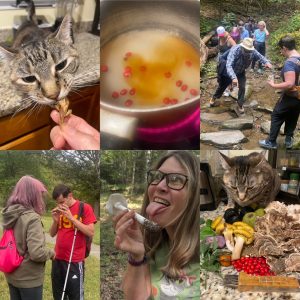
Image Block 2: Ninjette enjoying hen of the woods (and her good fortune to have such a fall bounty on her counter); spicebush berries for a vanilla spice syrup, me posing with a deadly destroying angel on Candise’s mushroom walk, and the intrepid blind athletes smelling “interesting” mushrooms and surviving the stream crossing I put them through.