
Happy June, food & foraging friends!
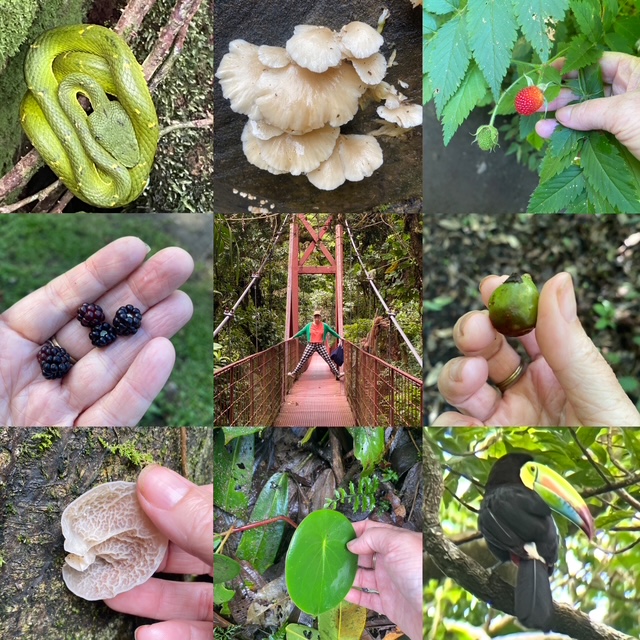
Pura vida! I’m recently back from the magnificent cloud forests of Costa Rica. Pooping sloths, roaring howler monkeys, comical coatis, shimmering hummingbirds, sleeping snakes, and a big-billed toucan squeezing into a skinny-jeans nest to feed her young: we saw it all.
Despite all that biodiversity, it was not an easy place to learn to forage. Having pressed three different guides to point out wild edibles on our walks through the cloud and rain forests, I came away pretty hungry. One of the few tastes I got was a medicinal plant so bitter I was told you might rather be sick rather than endure the taste (of course I had to try it, and it was as advertised.)
One of the richest sources of food and biodiversity in Costa Rica? The avocado. The bumpy black-skinned Haas variety of guac fame is just one of hundreds of species of avocado worldwide; a good hundred alone are native to Costa Rica’s forests. Avocado is part of the laurel family, which has such diverse members as sassafras and cinnamon. Even funner fact, it gets its name in Spanish, aguacate, from the Aztec for “testicle tree”. If you want to annoy your friends, correct them next time they call avocado a vegetable and let them know it’s actually a single-seeded berry in botanical speak. Check out Weird Fruit Explorer’s video taste-testing several types of avocado, from leggy to ginormous, he found in a San Jose market.
In the forest however, the avocadoes are largely for the birds, literally and figuratively. While not poisonous, the small-fruited species of avocado many birds rely on are about as palatable to humans as an unprocessed acorn. The ribbon-tailed Resplendent Quetzal swallows these hard-shelled fruits whole, later throwing up its seed, helping propagate the species. (Indeed, the thud of an avocado seed hitting the forest floor is apparently one of the bird’s giveaways for groups hunting for this beauty in the dense canopy. We were not so lucky.)
Back to the human’s-eye view of the cloud forest, I did get to try a wild species of vining peperomia akin culantro (not a typo, that’s different from cilantro), a bland berry called the roseleaf bramble I later learned was a Himalayan invasive, and a mountain blackberry I spent way too long on iNaturalist and listening this self-proclaimed weird fruit guy trying to pin down the species. Over in the fungal kingdom, I spied species of wood ear, oysters, and reishi. All in all, I uploaded observations of nearly 150 different species of plant, fungi and animal to iNaturalist, and that’s not even counting the few dozen bird calls I logged to Merlin. And really, we barely scratched the surface of this richly diverse land.
So enough about the birds, how about those berries. Back home, sweeter treats abound right now, in the form of my favorite fruit, the serviceberry.
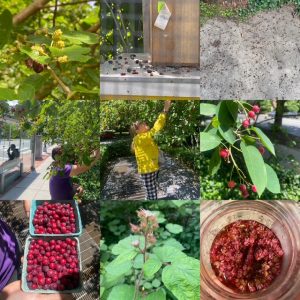
Also known as Juneberry, shadbush, or Amelanchier, the serviceberry is a North American native that grows on small shrubby trees and tastes like a cross between almonds and Hawaiian fruit punch. It’s also beloved by the bees, butterflies and birds, so leave some for the pollinators. Luckily for those of us in DC proper, the department of urban forestry has planted plentiful trees all over city for its residents to enjoy (check out the dense map of serviceberries created by Casey Trees.)
I found a whole grove of shadbush right at a bus stop on Connecticut Avenue, and came back with one of my BFFs (best foraging friends) to harvest as much as we could before the tree succumbs to the rust that has plagued many of our rose family trees (crabapples, hawthorn berries, etc) in past years. The fungal rust looks like colored spikes coming off the fruit, and tastes disgusting if you happen to get one or more in your batch.
While we gathered them shy of peak ripeness (when they turn deep purple) and therefore peak sweetness, they are no less delicious. I am usually not disciplined enough to save them for a dish, going from hand to mouth, but this time around I froze a good number to make a batch of Juneberry muffins for Juneteenth next week!
PS, about that name — one of many interpretations of serviceberry comes from Appalachian folk culture, as its blooming often coincided with the time when roads became passable enough for ministers to travel and hold memorial services in spring. It also was an ingredient in pemmican, Native America’s original energy bar, with dried fruit and meat.
Juneberries coincide with mulberry season. On my guided walks, I often tell people to remember to look up while foraging, because our street trees have many edible parts, from flowers to fruits to nuts. However the mulberry is one where you’re better off looking down, as you’ll often see the fruit staining the streets before you see the berries on the branches. A friend from my mushroom club sent me an adorable video last week of her dog eating every mulberry on the sidewalk like it was the high-scorer in a foraging game of Pac Man.
Another reason to look down? I got overzealous blindly reaching into a mulberry branch right opposite the Connecticut Avenue mulberries and fell into a massive hole off the sidewalk, badly bruising my butt and thigh. The dangers of urban foraging are often more about the side(walk) quests than the actual consumption of street food.
One helpful hint for foraging both of these berries: all composite berries that are on brambles (coming-soon attraction, wineberry) or trees (the mulberry) and berries with a crown (the serviceberry) are edible. It’s one reason why I felt confident in harvesting the blackberries I found in Costa Rica.
April
PS: I promised to report back from last month if I made those dandelion root cake, and it turned out delicious, in cupcake form topped with a cream cheese spicebush icing! But the harvesting and processing? Sufferin’ succotash, that was a lot of work for a little bit of root!
***
Image Block 1: Side-striped palm pit viper, oyster mushrooms, roseleaf bramble, mountain blackberry, suspension bridge, wild avocado, wood ear, peperomia, and a keel-billed toucan.
Image Block 2: White mulberries and a few stages of splat, serviceberry harvesting at the bus stop, wineberries ripening and milkweed flower shrub before straining.