
Happy March, food & foraging friends!
Just as spring started showing its colors, I snoozed winter this past week with a trip to the snow-capped Caucasus Mountains of Georgia.
The post-Soviet state had long been on my radar, having fallen in love with its cuisine through my neighborhood restaurant Tabla (sadly now closed; luckily its sister restaurant Supra is still on the map). The country boasts the world’s oldest wine culture, incredible plant biodiversity and some of the friendliest stray cats I’ve ever encountered, so you know I was in heaven.
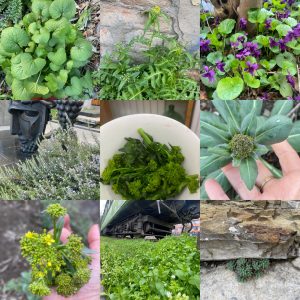
Starting in the capital of Tbilisi, I found much to forage. White and eggplant hued violets adorned the hilltop graves of acclaimed writers and national heroes in the Mtatsminda Pantheon. I snacked on chickweed blanketing the lush banks of the Mtkvari River. And on a lonely hillside trail where I shared leftover stewed mushrooms with a baby tabbycat, I found florets of a brassica similar to broccoli raab, which I cooked up as a pre-supper snack. On the same trail, I found scallops of garlic mustard (Georgia being part of its native region) and fields of anise-scented cow parsley (Anthriscus sylvestris). I “i-natted” several artemisia species, cousins to mugwort and wormwood, which a guide told me his grandmother used to spruce up home-cooked dishes. Next to a statue of Ronald Reagan (certainly not buried with Georgia’s heroes, but acknowledged for his role mending fences in the Gorbachev era) I found another peppery mustard whose tiny yellow cross-shaped flowers — a signature of the brassicas — were just opening. Researching other new-to-me plants, I discovered many only found in the Caucasus region, like zosima absinthifolia, a carrot family medicinal.
Read on to learn more about wild foods on the Georgian table!
The Georgian feasting tradition, Supra, is an all-night party featuring a massive spread of food and wine lead by a toastmaster (tamada). I got to experience a taste of the Supra on a day trip to Khaketi, one of Georgia’s acclaimed wine-making regions.
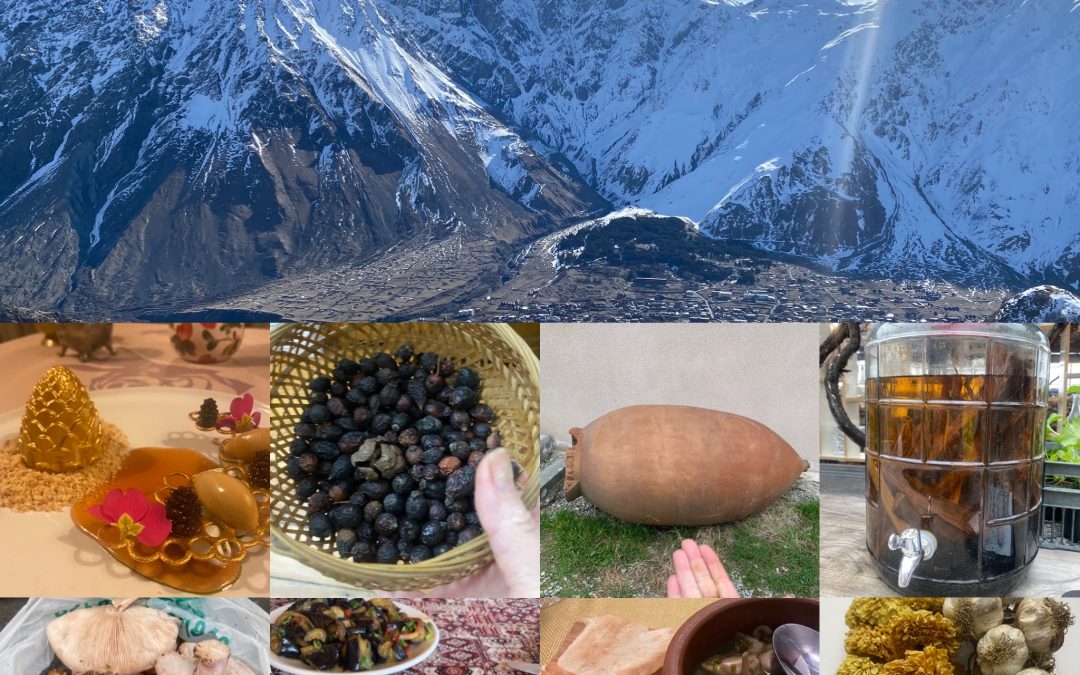
Side note on wine: Georgia’s Saperavi dethroned Iran and its native Shiraz as the world’s oldest known viticulture in 2017, when archeologists discovered an 8,000-year-old clay fermentation vessel near Tbilisi not unlike the qvevri still used by traditional winemakers today. The grape is central to Georgian living. Families all make their own wine at home, even in the cities, where you can see grapes trailing down apartment balconies. Grapes are part of a zero-waste culture: the seeds are pressed for oil, the leftover pomace is used to make chacha (a grape brandy that my late father would say would put hair on your chest), the leaves are used in cooking and the branches are used for barbeque.
Back at the supra, our open-air table was so crowded with dishes they had to be stacked and staggered. There were several kinds of pkhali (a vegetable pate with garlic, herbs and walnuts); khachapuri bread stuffed with cheese, egg and beans; tarragon-stewed mushrooms; several meats including barbequed pork and creamed chicken; fresh salads of cucumber, tomato and beet; and more, all washed down with amber and red wines (a nuclear green tarragon soda for the teetotalers). Yet one of my favorite things on the table was a vinegar pickle called Jonjoli, a sharp yet delicate counterpoint to the fatty comfort dishes crowding the table. Jonjoli is made from the flower buds (wild and cultivated) of the native Caucasian bladdernut, making it all the more special.
Sandro, my intrepid chain-smoking driver through the Caucasus mountains (intrepid as we were in a compact car with ill-fitting snow chains), also introduced me to Ekala, which I was delighted to discover was made from a local wild species of Smilax — young tendrils of greenbriar shoots you can snack on this spring in places like Rock Creek Park. While Sandro had a belly big as a wine barrel from eating khachapuri on the road, he said this native dish was the first thing he’d request and eat on repeat when back home to his family in Western Georgia.
There is so much more I could say about feasts and forages in Georgia: how I love that dried marigolds (Georgian “saffron”) are central to condiments, including the Svanetian salt and Khmeli suneli spice mixes I brought back to flavor my own wildcrafted cuisine (I am thinking of trying to make phkali with lambsquarters for my spring forager’s feast). I was constantly running into wild mushrooms in markets, menus and conversations, from a man selling a bag of foraged blewits on a city street and bolete-flavored crostini chips found in a gas station market to my driver-guide waxing on about Caesar mushrooms. Check out my Instagram for more on my culinary and other adventures (paragliding!)
I came home this weekend to find my neighborhood bursting with spring delicacies. This morning I made an asparagus and herb omelet, an annual spring tradition, from the first spears in my community garden plot, and spent much of yesterday gathering herbs and greens — mugwort, purple deadnettle, chickweed, yarrow, and violets, to name a few — for pesto, seasoning salt, infused vinegar, and more. Some plants, like yarrow, are best harvested young and tender, so carpe diem!
Wildly yours,
April
***
Image Block 1: Garlic mustard, chickweed, stonecrop, violets, rosemary and various brassicas were among the numerous wild edible plants I encountered roaming Georgia.
Image Block 2: The Causasus Mountains offered stunning scenery, while wild and hand-gathered foods like pine cones, rose hips, mushrooms, and flowers like marigold and the endemic Caucasian bladdernut were highlights of the Georgian table. One of the most ancient foraged plants is the grape, with over 500 varietals still surviving today. The clay qvevri fermentation vessel has been used to make wine in Georgia for at least 8,000 years).
| |