
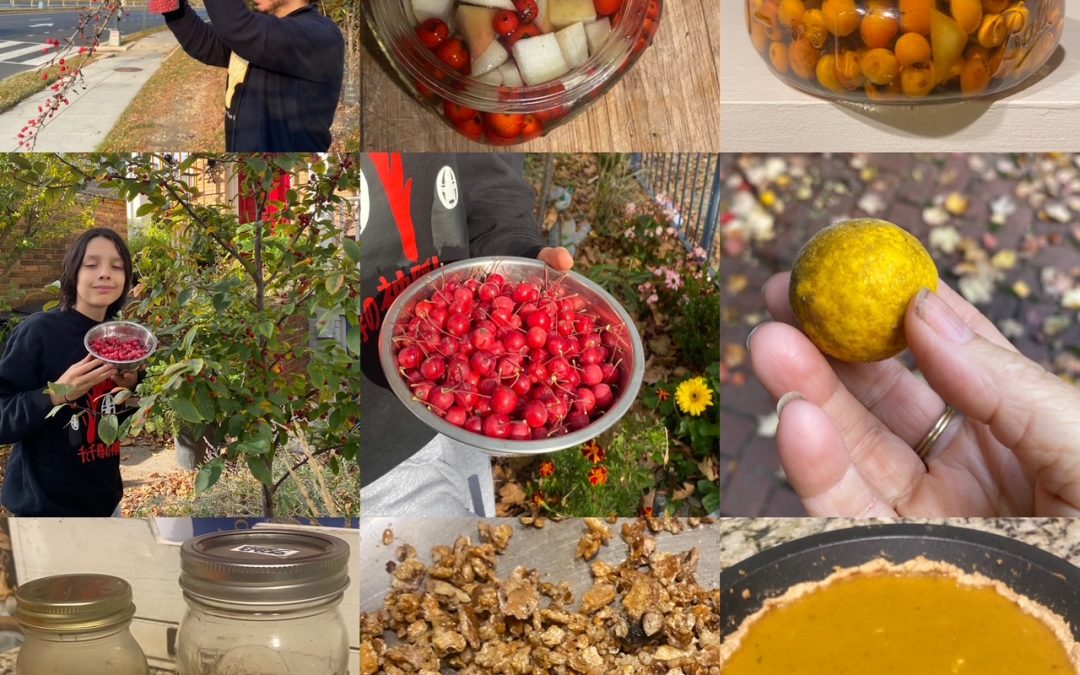
Happy November, food & foraging friends!
I’m often asked in my foraging workshops, “how much of your diet is actually foraged?” Most days I’m eating something I’ve foraged (and/or grown) myself, particularly greens, herbs, nuts, fruits and mushrooms, but most of my calories I buy, especially my dietary staples like eggs, beans, pasta and olive oil.
That’s why I was most intrigued when my friend and fellow forager Nevin gifted me a copy of Robin Greenfield’s book Food Freedom. Robin, then a neophyte farmer and forager, survived an entire year eating 100% foods he foraged or farmed himself — no “cheating” on things like spices, oils or produce from friends’ gardens. This year, Robin is surviving on foraged food alone. The food activist had also undertaken other challenges, like eating a typical American processed foods diet for 30 days and wearing every piece of trash generated by those meals, like a hairshirt. What’s more, his book is offered by donation, no required purchase price, and he donates everything he earns from it and talks to Gardens of Liberation, working to promote food sovereignty for Indigenous and Black communities. I’m inspired by Robin in every way! His book also tipped me off to Just Eat It, a great documentary about a couple who went six months only eating discarded food, and ate so well in the process, exposing the millions of dollars worth of perfectly good food pitched by stores and manufacturers every day.
These challenge diets are extreme by nature, not meant to be sustained. But one of proven benefits of setting an ambitious goal is that you will inevitably get closer to it than if you never set that goal at all. While I’ve got a pretty clean diet, environmentally and otherwise, many of my ethically sourced “healthy” snacks still come in disposable packaging; the aforementioned beans and pasta have often traveled a fair distance to arrive to my door. Could I try a month plastic-free or adhering to a 100-mile diet? How about even just one meal a week that is strictly grown and foraged by me– no cheats with oils and spices? I’m going to ponder a 2026 goal and share it here!
Another benefit of a food challenge is the awareness generated. I use a tracking app in an effort to drink more mindfully, and it definitely helps, though logging anything can be a slog. As I have been wrestling with these questions of food packing and miles traveled, I’ve become more aware of how incredibly little food purchased on the fly is available plastic free.
Speaking of big challenges, I’ve hit a milestone with my urban foraging book, due this spring, with 40% written. Knowing the importance of goal setting and monitoring to success, every week I add my progress to the word count and watch the “completion bar” slowly inch up. I’m learning a lot in the process of research it. For example, do you know what wild food is inspired the name for the color mauve? Or what medicinal plant was traditionally used as diapers, shoe inserts, torches, and a fish poison? How about which mint family flower can be blown like a little kazoo? (Read to the bottom for answers!
So, back to our regularly scheduled topic of foraging itself! This time of year, it’s a race to gather everything I can before nature’s kitchen closes for the season. And there is so much available! Visiting friends in NYC over Halloween weekend, we went for an urban walk in Brooklyn, finding near two dozen wild foods over the course of an hour. My friends’ son and I made a delicious syrup from crabapples and spicebush berries.
Other great forageables right now include nuts like black walnut, fruit like hawthorn and rose hips, late greens like chickweed and dandelion, pseudograins like amaranth, and for the adventurous, ginkgo nuts! I went on a great ginkgo walk this month with “tree guy” Sam Nelson, learning interesting facts like ginkgo having sperm and that its Latin name biloba comes from its two-lobed leaves. Not too late to catch the golden leaf shower of these ancient wonders on Swann Street!
I brought the roasted gingko nuts to my fall forager’s feast, but perhaps not surprisingly they did not get eaten up as quickly as my three-squash pie with spiceberry whipped cream and candied black walnuts. Gingko nuts are an acquired taste, having a bitter aftertaste and a gummy texture, but they have lots of nutritional benefits. Don’t overdo it though — they contain a toxin (imaginatively named ginkgotoxin) that is only of concern if you eat more than a handful a day.
Speaking of not overdoing it — wishing everyone a safe joyous and bountiful Thanksgiving; don’t forget to pace yourself at the table!
Wildly yours,
April
PS: About those trivia questions – the first one (re mauve) is mallow, the second is mullein and the third is henbit.
PPS: Holiday shopping season is here, and I would love it if you’d consider making a purchase from the Chronic Market, my platform for chronically ill artists around the world!
***
Image Block 1: Top row, foraging hawthorn berries for tincture and syrup. Middle row, foraged crabapples and trifoliate orange in NYC. Bottom row, black walnut husk bitters, black walnuts and squash pie with spicebush berry and other warming spices.
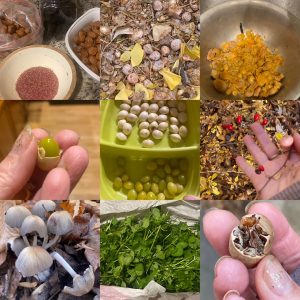
Image Block 2: Stinko ginkgo berries at different stages of processing, amaranth seeds, Japanese barberry, inky caps, chickweed and pignut hickory (horribly tannic!).