
Happy February, food & foraging friends!
Tis the shortest month, but packed with holidays – Lunar New Year, Valentine’s Day, Groundhog Day, Ramadan, and, ahem, (not my) President’s Day – not to mention Black History Month!
I know most of you know Alexis Nelson, aka Black Forager, America’s wild food darling of the century… I like to humble-brag that she messaged me about some of my wild food stories on Facebook before she got untouchably famous, though now you’d never know we shared a hometown (Columbus, Ohio!)
Alexis’ Tik Toks and IG posts are a master class in foraging. But she also offers important commentary and context on race and foraging that I encourage everyone to take time this month to learn about. Put bluntly, foraging laws in this country and elsewhere (see: Palestine) historically have been a device to control and oppress. This incredibly good read on the history of foraging laws goes into the details of these anti-foraging laws being “grounded in racism, classism, colonialism, imperialism, or sometimes…all of the above,” as well as the modern iterations, and how incredibly byzantine, arbitrary, and contradictory (not to mention up to the whims of individual park superintendents) they can be.
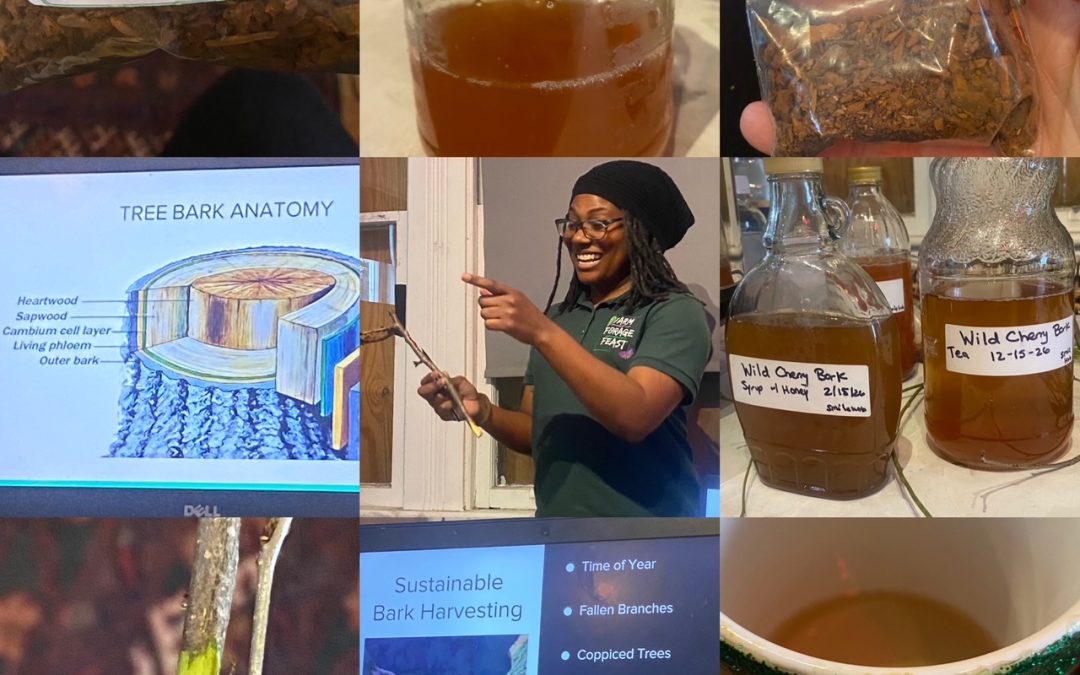
Locally, we are lucky to have some wonderful black wild food educators to learn from, as I did this weekend with one who has come to be a friend, Candise Jordan. Candise, whose business is called Farm Forage Feast, has a Fearless Foragers Club where newbies can learn to forage through a hands-on, season-long program.
I proposed a class trade — come sip evergreen cocktails with me at ANXO in exchange for me learning how to sustainably harvest and use tree bark from Candise. (Bark is essentially the skin of the tree, and I’ve just been too cautious to play around with it!)
Like me, Candise thinks of evergreens as Mother Nature’s winter medicine, and we enjoyed a delicious, piping hot cup of pine needle tea in class. She covered a ton of great material and species for winter wild medicine using roots and barks, including spicebush, sassafras
One tip I picked up from Candise is to keep your simmering teas covered so the volatile oils don’t escape — unless you’re aiming for aromatherapy in your home, as I did yesterday afternoon, with spruce, tangerine peel and hawthorn berry simmering on the stove! She goes hard with these ingredients when making tea for medicine rather than pleasure, saying “I like it to kick me in the face as I taste,” which sounds like a great t-shirt slogan, if you ask me. Her sassafras root tea indeed had quite a kick, which I quite loved. Oh, and about that sustainable bark harvesting: Candise talked about gathering branches after a strong winds and making friends with neighbors when it’s tree-pruning time, among other tips.
Candise has a winter tea and tree ID workshop coming up February 28 where you can learn all this and more, so check her out!
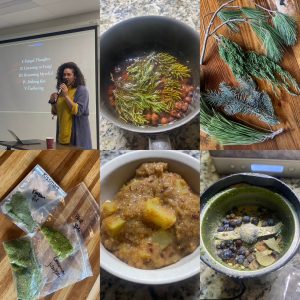
I hopped straight from Candise’s class to hear another epic educator (and a fellow Wahoo, being a PhD candidate at UVa!) speak to our mushroom club. Gabrielle Cerberville, aka Chaotic Forager, riffed on themes from her new book Gathered. Musing philosophically and metaphorically on foraging and fungi, Gabrielle encouraged us to think like fungi, referencing some of the things they embody — opportunity, connection, exchange, and interdependence to name a few — and to resist anthropomorphizing their activities, which detracts from and diminishes their essence.
While I don’t have any new foraging workshops scheduled yet, you can come hear both me and Candise speak on March 7 at Rooting DC, her on wild foods and me on my day job geekery, Bloom and other soil amendments! It’s a fantastic free convening of urban agriculture enthusiasts.
You can also find me next Saturday freezing my sassafras off at the National Harbor for the Chesapeake Climate Action Network’s (modified) Polar Plunge. I don’t need to tell you how climate change could upend our water and food systems, both wild and cultivated, in our lifetime. I’m less than $100 short of my fundraising goal; make a donation to support CCAN’s work to keep winter cold!
Wildly yours,
April
Image Block 1: Candise in action teaching on all things wild winter barks and roots, including wild cherry, sassafras, willow, spicebush and pine.
Image Block 2: Chaotic Forager Gabrielle Cerberville speaking to MAW this weekend; my hawthorn, spruce and juniper decoction; evergreens, whole and ground from my ANXO class; a wild amaranth breakfast cereal I made from seeds saved last season; and a juniper spice rub before the grind.
| |