
Happy August, food & foraging friends!
I just got back from a family reunion, where my sister wore a “F*ck summer” hat. As siblings, we bicker about many things, but on this point I must agree. I find the summer heat and humidity generally unbearable. And having had a precancerous spot on my lip recently zapped, I have come to think of the sun as a frenemy that’s cheery when you’re together, then stabs you in the back!
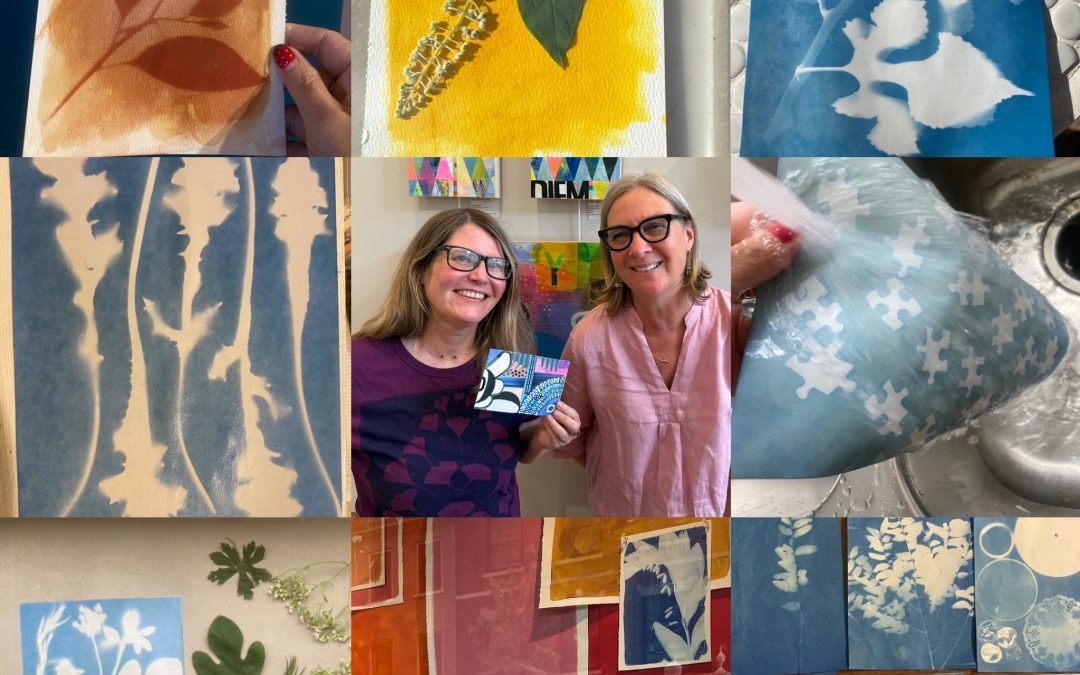
All that said, I have a new appreciation for the sun’s alchemic properties and how we can harness them artistically. For a while now, I’ve been dabbling in cyanotype printing, essentially the world’s first photographic process, discovered in 1842. In scientific terms, cyanotype is a photochemical reaction in which ultraviolet light changes soluble iron compounds into an insoluble blue pigment.
The process itself is pretty simple: arrange objects on chemically treated paper, leave in direct light for a few minutes, then rinse the paper to fix the design. The process lends itself beautifully to foraged plants, preserving their silhouettes as lasting reminders of their distinctive shapes and identifying characteristics.
Cyanotyping brings me back to pre-digital days, when I used to play around in the darkroom – a similar process of playing around with exposure times, then rinsing photographic paper in different chemical baths. Some cyanotypists (my word) use negatives just like the traditional photographic process to make gorgeous prints like this one. The resulting beautiful indigo color is actually the Prussian blue used by many artists throughout history, including Hukosai’s iconic The Great Wave off Kanagawa woodblock print.
The process can also be done on fabric. Diane Sidener, a Pennsylvania-based artist and vendor in the Chronic Market, my platform for chronically ill artists, cyanotypes beautiful t-shirts and pillow covers with native plants. Check out a photo below of me sporting one of her beautiful ginkgo leaf shirts!
I’ve been transforming plants into watercolors for a while now, so learning that there was a similar printing process using plant pigments made my heart sing. Anthotypes (“antho” = ancient Greek for flower) use juices from strongly pigmented plants like elderberries or pokeberries. It’s a similar process, only the plant juice rather than chemicals are coat the paper, and these prints require much longer exposure times. There is also a final step to fix the print that involves changing the pH through baking soda (basic) or vinegar (acidic). This blog gives a nice history of the art and science.
Turmeric is a classic anthotype base. The curcumin in turmeric not only is strongly pigmented, but also quite photosensitive. I tried turmeric anthotyping and got a nice pokeweed print my first time attempt!
I’ve had as many misses than hits, but it’s about the process as much as the result. I tried printing several from my hotel window before realizing the window blocked the UV light and caused the design to be completely underexposed. I also had the wind carry plants away mid-print. With anthotyping, I discovered that plants often curl up over the longer exposure time, changing the shape in a way that smudges the outline. (It’s why tan lines from shirts and sandals show up so well – firmly held objects shading our bodies!) Clear glass or plexiglass over the design helps to keep the shapes in place, provided your subject is flat.
These science-art experiments have tuned me into my environment in new ways. I never noticed the UV index that’s part of my weather app until now, or whether my alley gets morning or afternoon sun. For skin health, high UV exposure is a bad thing, but it’s preferable for a crisp cyanotype or anthotype. There are so many environmental variables, from cloud cover to time of day, that can affect your print.
I’m a lifelong collage artist, which is a similar process in some ways, but with cyanotyping, you have to work fast and not overthink your design, which I love about the process. I’ve made prints on the fly in parking lots and printed them in gas station bathrooms!
Another wild art project I’ve got underway is iron gall ink, which was used to pen medieval manuscripts as well as the US Constitution. I took a virtual workshop taught by Natalie Stopka as part of the 2026 Smithsonian Folklife Festival (what little was left of it this year). Not entirely unlike cyanotypes, the ink results from the chemical reaction between dissolved iron and the tannic acid in oak galls or other plant material. As Natalie explained, “It was the predominant writing ink in the European sphere from the 5th through 19th century, as it is completely indelible.”
Oak galls are plant growths on leaves and twigs tiny gall wasps form their larvae in; for the ink, you gather the empty galls the insects leave behind. I was excited to learn that some of my local forageables – namely sumac leaves, acorn caps and pomegranate rind (yes, pomegranate trees grow in my neighborhood!) – could be proxies for the galls. I foraged the iron as well, finding a bit of rusted post in my community garden to take home and submerge in vinegar and a dash of salt. (This scary looking substance also got used in a class exercise for a horror film workshop I’m doing at the library!) My only purchased ingredient was gum arabic, derived from the acacia tree. Gum arabic helps fix the ink, though I learned that the spring sap of cherry trees will do the job too.
Lucky for me, my friend Cindy, a preservation science specialist at the Library of Congress, happens to be an expert on the matter and had some galls to spare too. Cindy is a master brewer too and we got together to make a medieval gruit using mugwort and yarrow I also foraged from my neighborhood. Both ingredients were staples of beer making before hops, stay tuned for the results of that! While the galls are still fermenting, I was happy to get a lovely deep gray ink from the sumac leaf-iron mix.
While I haven’t mastered these techniques, I’ve experimented enough to know how fun and easy they are to play around with. Later this month, I’ll be leading a few of my classic cider and forage workshops at ANXO, with a cyanotype add-on. If you’ve done my foraging intro class before, come back for a refresher and to make your own foraged cyanotype! You’ll get to try the last of a delicious persimmon-based cider ANXO has on tap as well.
If you missed my usual food talk this month, check out this video City Cast produced of me foraging wild summer edibles in my community garden. If I had to pick one wild ingredient to represent summer, it would be purslane. This sun-worshipper thrives on long, hot summer days, and I’ve been embracing it in my diet as one of the healthiest foods on the block. During a recent foraged dinner party, I made wild purslane and wood ear summer rolls, purslane flatbread, and purslane chimichurri. Tis the season to eat the things that eat the sun!
Wildly yours,
April
***
Image Block 1: A turmeric anthotype, various cyanotype experiments, me in a cyanotyped tee with fellow collage artist (who also does cyanotypes!) Jennifer Wilkin Penwick, a collection of cyanotypes in a Lancaster, PA gallery.
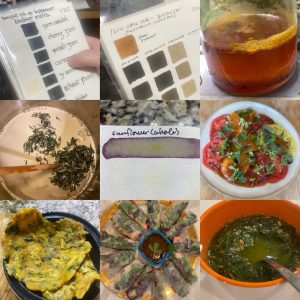
Image Block 2: A few pages from Cindy’s gall ink log, gruit brewing, sunflower paint extraction, my wild purslane on a fancy Poplar appetizer as well as three other purslane preparations, flatbread, summer rolls and chimichurri.