
Happy July, food & foraging friends!
The Fourth of July holiday has always been a mixed bag for me. There are so many things to celebrate about America, yet our history has an ugly underbelly that is currently in full view. As a DC resident, the rallying revolutionary cry of Taxation without Representation falls particularly flat, since we still pay more taxes than many states without representation in Congress or full self-governance.
The idea of independence and freedom is so core to our nation’s identity, and yet the reality of interdependence has always more deeply resonated with me. We cannot exist without others who grow our food and nurture our land and do the myriad other things that allow us to survive collectively and individually. And in the words of civil rights icon Fannie Lou Hamer, “Nobody’s free until everybody’s free.”
Knowing about the myriad wild foods growing all around us, from city to suburbia to rural America, does provide a certain food freedom (and free food)!
In my last newsletter I promised a food and foraging recap of Minneapolis. The Twin Cities absolutely exceeded my expectations. Thirteen tranquil lakes, quirky art and sculptures (including crop art!), a swirl of cultures (Scandinavians, Somalis, Hmong and the original inhabitants, the Lakota Sioux, to name a few): this is the best of America. I also took time to pay my respects to two defenders of democracy, Alex Pretti and Renee Good, visiting homespun memorials on the streets where they were killed defending their neighbors from ICE. Alex and Renee’s sacrifices make me proud to be an American today. Speaking of freedom, I also got to hear a free concert by the Minneapolis Freedom Band with one of my lovely couchsurfing hosts. Happy Belated Pride!
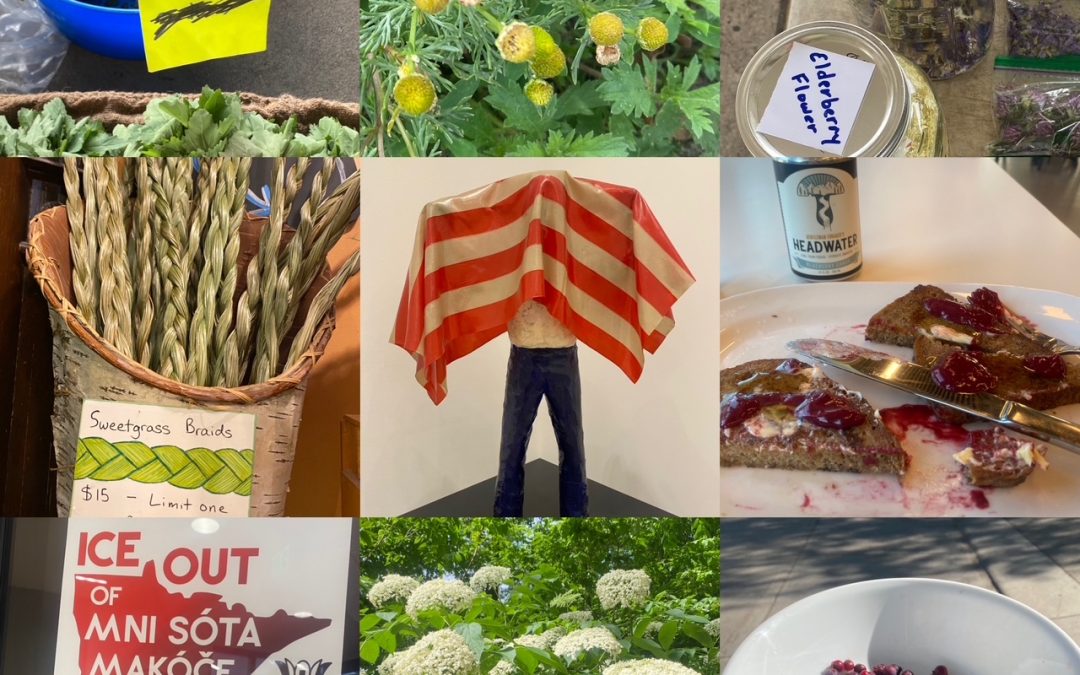
I had a number of wonderful wild food encounters in Minneapolis. At the city’s main farmers market, I connected with Hmong growers, who sold nutritious weeds like lambsquarters and amaranth alongside cultivated crops, and bought dehydrated chokeberries. strawberries and elderberries from another vendor. I learned about haskap (aka honeyberry), a berry only growing in these Northern climes, and got invited to tour one such farm. I snacked on wild rocket and spied wild sumac along Father Hennepin Bluff Park beneath the Historic Stone Arch Bridge. I stumbled on an entire grove of ripe serviceberries just steps from my hosts’ home on Cedar Lake, berries we threw into our morning fruit and oatmeal bowls. And I took a lovely stroll with a fellow forager, Maria of Four Seasons Foraging (who just happened to be a Wild Life subscriber!), admiring thick patches of lacy elderflower on a bird sanctuary walk next to Lake Harriet.
One of my most cherished food experiences of Minneapolis was tasting the creations of Native American chefs. I got lucky to get a reservation to Lakota chef, food educator and restauranteur Sean Sherman’s new restaurant Indígena by Owamni, an expansion of his prior restaurant and an extension of his work on food sovereignty, on opening day.
Every single ingredient used in Sean’s cooking is indigenous to the Americas, which means corn in lieu of wheat, bison instead of pork, duck eggs in place of chicken, sumac substituting citrus. His menus highlight the rich dietary diversity achievable outside of imported food.
Dining at Indígena, we sipped on cocktails brightened with sumac, enjoyed sopes topped with pumpkin puree and rich ground elk, and shared the showstopper, a huge portion of wild-caught salmon on a bed of seaweed and huckleberry tomato aioli, topped with foraged herbs such as goldenrod and bee balm.
I also made the trek across town to have breakfast at Gatherings Cafe in the Minneapolis American Indian Center, showcasing delicious, nutritious native foods. I hummed my way through a delicious wild rice French toast with wojapi (a native berry sauce) and maple syrup, washed down with a blueberry chaga seltzer. Maple syrup is a key ingredient in Native American cooking, as honeybees as well as sugar (and the slavery needed to power for the crop) were imported by Europeans. I brought some syrup home from Louise Eldrich’s local bookstore, Birchbark Books and Native Arts, which features an incredible array of Native American and progressive authors (including an entire shelf dedicated to Louise’s award-winning fiction), as well as other native products, from braided sweetgrass to wild rice. All in all, Minneapolis did not disappoint!
This holiday, I’m furthering my knowledge of indigenous foodways with three books: A Feather and a Fork: 125 Intertribal Dishes from an Indigenous Food Warrior by Kickapoo chef Crystal Wahpepah; Iwígara: American Indian Ethnobotanical Traditions and Science by Indigenous scholar and Rarámuri ethnobotanist, Enrique Salmón, and Sean Sherman’s history-cum-cookbook
Turtle Island: Foods and Traditions of the Indigenous Peoples of North America. You can find them at the DC Public Library, once I return the first two!
250 years seems long, until you take the point of view of the peoples who have inhabited this land for 15,000 years or more. Our modern connection to many of the foods we enjoy on our tables today, including all-American dishes like blueberry pancakes with maple syrup, directly hails from indigenous knowledge-keepers. There goes that interdependence again.
Today I’m serving up some seared milkweed pods and dressing a salad with a sumac maple syrup vinaigrette, both from Sean Sherman’s cookbook, alongside juicy slices of watermelon that hails from… the Kalahari Desert. We can celebrate our native foods while welcoming our food immigrants too, that make our lives and tables all the richer.
Wildly yours,
April
***
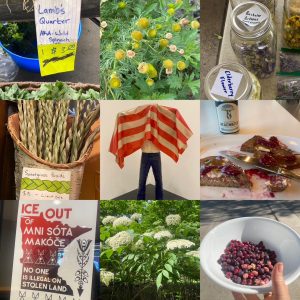
Image Block 1: Lambsquarters, pineapple weed, and dehydrated herbs and berries at the farmer’s market; breaded sweetgrass, wild rice French toast, elderflower, and serviceberries among the many wild foods of Minneapolis.
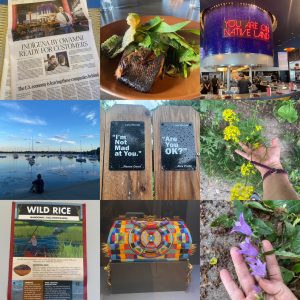
Image Block 2: The grand opening of Indigena by Owamni, wild lakes, wild rice, wild mustard and edible bellflowers among other Twin Cities foraging highlights.